Merz in Beijing: Political Lifeline or Strategic Recalibration?
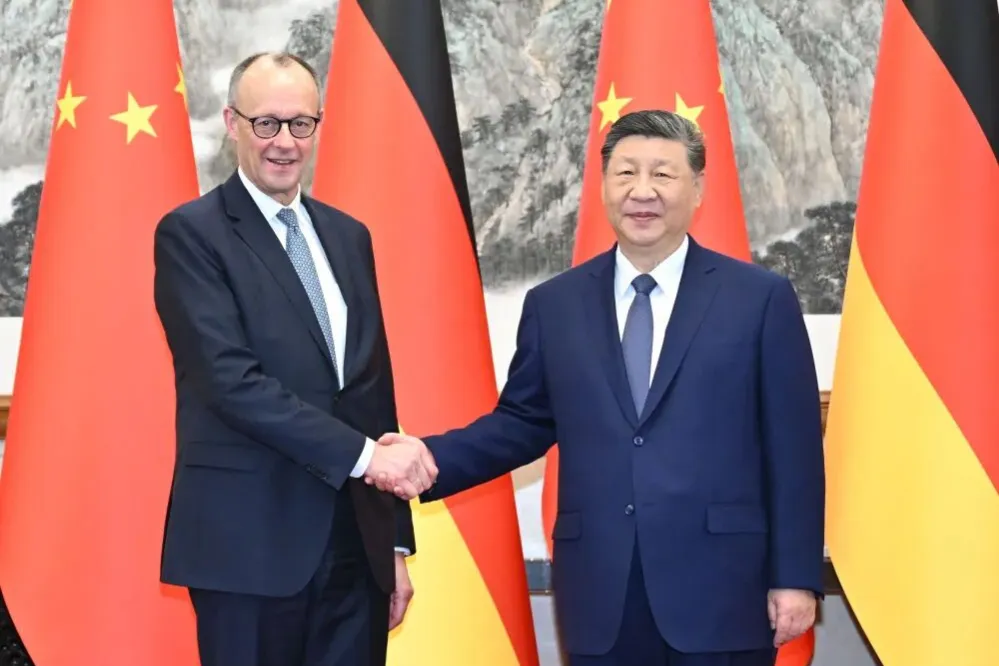
Merz arrived in Beijing at a time of mounting domestic pressure in Germany. Economic stagnation, the long shadow of the war in Ukraine, rising living costs, and industrial slowdown have left Berlin navigating growing public dissatisfaction. In this climate, the visit appears designed to secure tangible external gains that could bolster the government’s credibility and reinforce its economic management narrative.
The German leader’s call for “fair and transparent competition” in trade with China, coupled with a sizable business delegation and agreements on climate cooperation and industrial transformation, underscores Berlin’s increasing reliance on Chinese market access. This outreach reflects economic necessity rather than strategic confidence. Foreign policy, in this sense, is being deployed as an instrument to stabilize domestic legitimacy.
Europe’s Eastward Tilt
Merz’s insistence that monetary and trade matters be addressed within the framework of the European Union highlights a broader continental trend. Several European leaders have recently engaged Beijing, signaling a coordinated reassessment of Europe’s China policy.
With ties to Russia significantly reduced, dependence on costly American energy and defense supplies rising, and inflationary pressures intensifying, Europe is seeking to diversify its partnerships. China is viewed not merely as a commercial partner but as a geo-economic stabilizer. While European capitals hope to influence Beijing’s stance toward Moscow, economic imperatives appear to outweigh geopolitical ambitions.
This shift suggests a structural transformation in global power dynamics — one that is compelling Europe to move from value-driven prescriptions toward pragmatism rooted in strategic necessity.
Transatlantic Strains and a Changing Order
For decades, Europe’s security and economic architecture rested firmly on its alliance with the United States. That foundation is now under strain. Trade frictions, unilateral tariff policies from Washington, and increased defense burdens have widened transatlantic divides. Merz has previously questioned Europe’s overreliance on the U.S. and criticized confrontational approaches toward blocs such as BRICS.
Within this context, the China visit carries strategic symbolism. It reflects a gradual recognition in European capitals that the era of uncontested American unipolarity is fading. Debates at forums like Davos and the Munich Security Conference further illustrate this evolving discourse.
Europe increasingly acknowledges that exclusive dependence on Washington no longer guarantees security or sustained economic growth. Engagement with Asia, particularly China, is emerging as part of a broader balancing strategy.
Persistent Strategic Contradictions
Despite this recalibration, Europe remains constrained by internal inconsistencies. Ongoing military backing for Ukraine, expansive sanctions regimes, and political alignment in global crises complicate claims of strategic autonomy. These contradictions limit Europe’s flexibility in dealing with emerging powers.
While deeper engagement with China may slow Europe’s relative decline, durable results will require a more comprehensive reassessment of interventionist policies and sanction-heavy frameworks. Merz’s Beijing trip thus represents more than a tactical maneuver — it signals Europe’s cautious adaptation to a multipolar order in which power is more diffused and alignments more fluid than in the past.