Escalation or Restraint? The Strategic Crossroads Facing Washington
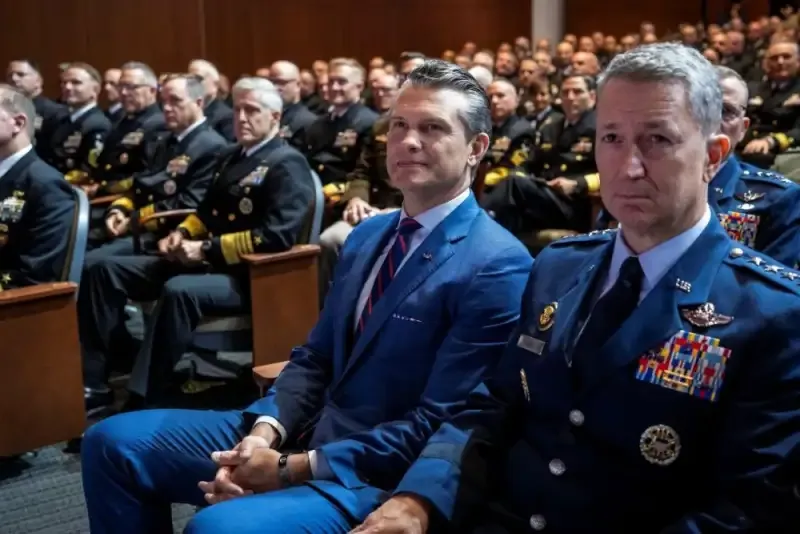
The simultaneous publication by three major U.S. outlets of a negative assessment by America’s top military official regarding a potential war with Iran is no ordinary news cycle development. It amounts to a structural warning signal from within Washington’s decision-making apparatus—one that challenges efforts by former President Donald Trump to frame military confrontation as swift, decisive, and manageable.
Reports by The Wall Street Journal, The Washington Post, and Axios cited General Daniel Caine, the highest-ranking U.S. military official, as saying that American commanders believe a war against Iran would be “difficult and consequential.” The coordinated timing of these reports suggests more than a routine policy disagreement; it points to a deliberate transmission of concern from within the national security establishment.
Trump’s swift and forceful response, delivered on Truth Social, reinforced that interpretation. He categorically denied the reports, attacked the media as purveyors of “fake news,” insisted that General Caine “knows only victory,” highlighted the power of B-2 bombers, and declared that “the final decision is mine.” Yet the intensity of the rebuttal appeared less a demonstration of readiness for war than an attempt to reclaim narrative control from institutions now emphasizing the potential costs of conflict. If the reports were entirely baseless, such a personal and expansive response might not have been necessary.
In the U.S. political system, strategic leaks often emerge when segments of the power structure seek to raise the political and social cost of high-risk decisions before they are made. When three respected outlets quote the nation’s top military officer warning of broad and difficult consequences, the debate shifts from the feasibility of rapid action to the strategic and regional fallout of war. That reframing directly constrains presidential maneuverability and signals to both Congress and the public that the war scenario is neither simple nor low-cost.
Reactions from figures aligned with Trump’s camp further underscore the significance of the episode. Laura Loomer and Mark Levin angrily denounced what they described as an “internal White House leak” on Iran, calling it damaging to the president. The prominence of the term “leak” among loyalist voices suggests that even within Trump’s media orbit, there is recognition that sensitive internal assessments have surfaced publicly—an indication that internal divisions may have moved beyond quiet deliberation.
Another notable shift lies in Trump’s rhetoric toward the Iranian public. According to Steve Witkoff, the president expressed surprise that Iran appeared “unafraid.” In deterrence theory, a threat is effective only if it is believed and its costs are taken seriously. When threats fail to produce the intended psychological effect, pressure tools erode, and decision-makers often escalate the scope of their warnings. Trump’s more recent implication that “the people will also suffer” if no agreement is reached represents a departure from his earlier effort to distinguish between the Iranian government and its population. The pressure is no longer confined to the ruling structure—it is broadened to society at large.
Yet such an approach carries serious risks of miscalculation. Historical experience suggests that when an external threat approaches an existential threshold, societal reactions do not necessarily translate into bottom-up pressure against governing authorities. More often, internal cohesion mechanisms are activated. Expanding threats to civilians may reduce prior constraints on retaliation and widen the scope of countermeasures—precisely the scenario that fuels skepticism among segments of the U.S. military about the controllability of war’s consequences.
The influence of narratives close to Israeli Prime Minister Benjamin Netanyahu also figures into the broader calculus. In these accounts, escalating pressure is framed as a pathway to coercion—or even collapse—without sufficient consideration of Iran’s structural logic of survival under threat. Such assumptions risk pushing escalation to a point where the opposing side interprets actions as existential, thereby maximizing its resistance capacity rather than capitulating.
From a strategic standpoint, the central challenge in launching a military strike on Iran is not America’s hard-power capabilities but the profound uncertainties of a regional war. Such a conflict could extend beyond direct state-to-state confrontation, draw in non-state actors, and expose U.S. and allied interests across a vast geographic arc. American military planners are keenly aware that even tactical success would not automatically translate into strategic victory.
Viewed through the lens of game theory, the current moment resembles a test of threat credibility. If a threat is not perceived as credible, the actor issuing it must either escalate or pivot toward negotiation. Trump’s forceful reaction and sharpened rhetoric suggest an effort to restore deterrent credibility. At the same time, the leaks and indirect warnings from military circles have raised the political and strategic costs of that path.
Taken together—the coordinated disclosures, Trump’s rapid rebuttal, the protests from his media allies over internal leaks, and the broadened scope of threats toward Iranian society—these developments point to a genuine debate within the American power structure over the risks and consequences of war. The central question remains unresolved: will decision-making be driven by a logic of rapid coercive pressure, favored by more hardline pro-Israel factions, or by a calculus of caution in the face of a conflict whose scale and aftermath may defy control?