Cost-Competitive Catalytic Process Converts Plastic Waste into Toluene
In recent years, plastic recycling has evolved from a purely technical concern into an economic and environmental imperative. Among common plastics, polystyrene (PS)—widely used in food packaging and consumer products—poses a particular challenge due to its chemically stable structure, which makes effective recycling difficult.
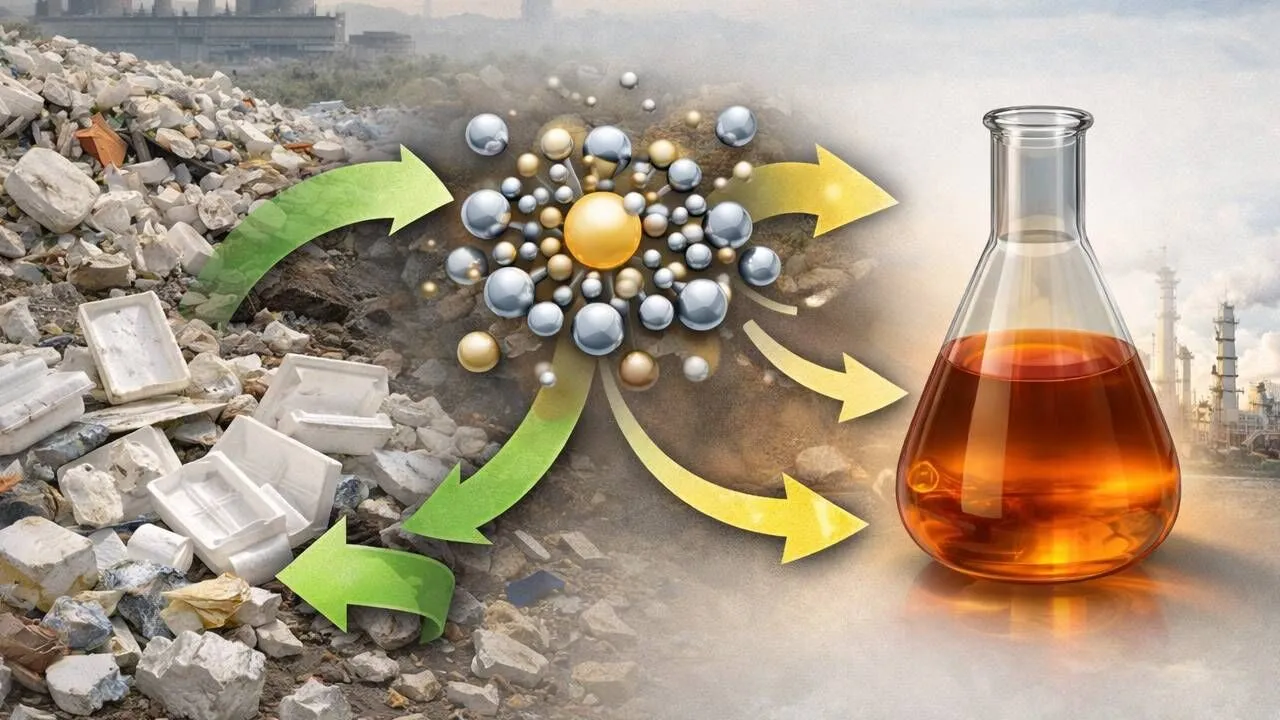
A new study by Chinese scientists introduces a novel pathway for the “value-upgrading” of polystyrene waste. The core of the method lies in a two-stage reactor system employing single-atom ruthenium (Ru) catalysts. In the first stage, solid polystyrene is subjected to high temperature and controlled pressure, undergoing pyrolysis to break down into smaller molecular vapors. These vapors are then fed into a second reactor, where—under a hydrogen atmosphere and in the presence of single-atom Ru catalysts—they are selectively converted into toluene via hydrogenolysis.
According to Dr. Zhedong Zhang, one of the study’s authors, tuning the ruthenium active sites at the atomic scale plays a crucial role in controlling reaction selectivity while maintaining high catalytic activity. He notes that this strategy successfully addresses a long-standing challenge in catalytic chemistry: the trade-off between yield and selectivity.
Laboratory results show that the process achieves over 99% selectivity and approximately 83.5% yield for toluene production—figures considered remarkable for a plastic-waste-based process. Moreover, life-cycle assessments and techno-economic analyses suggest that this approach could reduce the carbon footprint of toluene production by up to 53%.
From an economic standpoint, the technology also appears promising. Estimates indicate that toluene can be produced at a cost of around USD 0.61 per kilogram, which is lower than the average costs associated with conventional petrochemical routes. This economic advantage, combined with reduced carbon emissions, could facilitate future commercialization.
To assess scalability, the researchers conducted experiments beyond the laboratory scale, increasing feedstock quantities and employing larger fixed-bed reactors. The results demonstrate that catalytic performance and reaction selectivity are retained at higher scales.
The research team believes that this two-stage catalytic hydrogenolysis strategy offers a practical route for converting plastic waste into valuable petrochemical feedstocks. As global industry seeks pathways toward a low-carbon and circular economy, such technologies could bridge waste management, emissions reduction, and the sustainable production of essential chemicals.